The following article appeared in the print issue of Ponca City Monthly magazine, which includes hyperlocal stories about Ponca City. Get full access to all online articles, videos, and content by becoming a paid subscriber. We offer free and paid subscription plans. Find rack locations to pick up your free print copy here, or subscribe here to get online access plus exclusive content.
April is the month gardeners wait for all year. The month of planting, of safely sowing seeds and of cleaning up the yard … well, for me at least.
All March, I have been holding the hubby (and myself) back from really cleaning up the yard: the mowing, the whacking of old plants and the pulling up of sticks and stems left over from last year. Why? you ask. Well, pollinators to be specific. In these piles of leaves, stems and sticks are ladybug eggs, solitary bee babies, walking stick egg sacs and of course, spider egg sacs. But with the advent of April, let the cleaning (and planting) begin.
Starting
If you are like me, you paid someone else to start some seeds for you (thank you Sunny Creek Trading Post) or you are visiting your local greenhouse for some plants (Greenfields and A Painted Leaf Plant Studio) or you are waiting for the Herb Festival to buy ALL the plants. Whichever way you lean, hardening off your starts (baby plants) to acclimate them to the Oklahoma wind, sun, lack of sun and heat/cold is necessary (See Planting below).
And it isn’t too late to start some heat-loving plants from seed in April. Okra, bean and basil plants sprout and grow quickly. They also don’t like cold weather, making a later transplant in May or early June ideal for them. If you want a fun vining spinach-like plant, try Malabar spinach. It loves heat, will grow all summer and subs quite nicely for spinach greens in salads and on hamburgers. Bonus: you can use the purple-blue berries to dye things with the kids.
Sowing
This is my favorite. The time has come to throw some seeds; or meticulously plant them in very organized rows according to a well-thought-out and designed schematic. But that is not me. So, sowing/throwing seeds is where we are right now. There is a butterfly plot I have been seeding every two weeks since January; I have thrown out a few pounds of clover seed all over the yard; and the lettuce seeds were scattered in their plot last week. But enough about my yard. Now is the perfect time to get broccoli, cauliflower, kale and all its relatives, as well as carrots, beets and radishes into the ground. And it’s not too late to get the seed potatoes in the ground or bury some of those potato eyes from your cupboard potatoes.
Also, keep an eye out for returning plants from last year’s fallen seeds, fruit plants like blueberries and strawberries or biennials such as sage, parsley, kale or mint … mint, glorious mint!
Planting
There are a lot of ways to prep the yard for planting: tilling, lasagna gardening and raised beds are just a few. Tilling is pretty self-explanatory. If you are a tiller, understood. I probably can’t change your mind. Lasagna gardening is a way to kill weeds and add nutrients to the soil, but it does take a little time. If you are not ready to plant in April, and have some time, this might be a method to prep your garden area.
Take brown cardboard and newspapers and lay them down two to three thick, covering all the grass/weeds. If you have old leaves lying around, layer those on next. The next layer can be compost or compost scraps (they don’t have to be completely broken down). The next layer can be topsoil, garden soil or your own soil mixture and then cover that with a layer of straw or mulch (grass clippings, mulched leaves, etc. …). Water each layer well as it is put down, and then water the whole “lasagna” area every couple of nights. You can also do this prep inside a raised bed. This will save on buying so much soil to fill the raised bed.
If you are planting close to the last frost date, make sure to harden off your new babies. Steps to harden off plants:
Begin hardening off 7-10 days before transplanting outdoors.
Commence by placing plants outside in a shady, protected area for one to two hours a day for two to three days. Bring them back inside after two hours (before dark).
For sun-happy plants, put them in the sun for longer hours after the first three shady days. For partial shade to full shade, keep using the shady, protected areas.
No wind for the first five days as the plants can snap or dry up. Keep them in a protected area either with a windbreak or in a covered container.
After 8-10 days, your plants should be ready to be transplanted. To reduce stress on you and the plants, transplant in the evening. Some say a cool, cloudy day, but as we know, Oklahoma weather can turn on a dime. At least you know the sun will go down and not reappear for 10-12 hours.
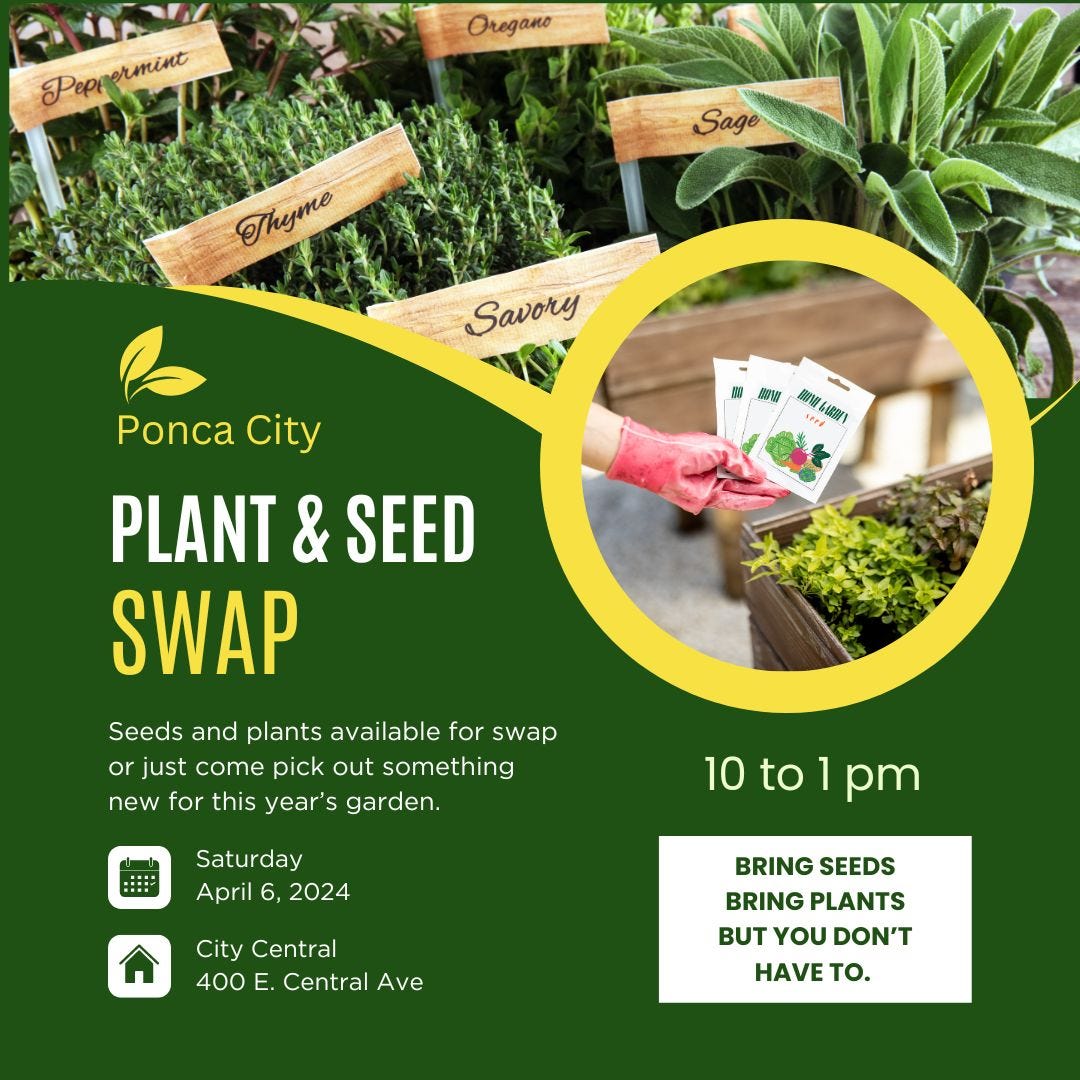
If you still are missing a few specific plants or you want to check out other people’s seeds and plants, The 6th Annual Seed Swap is happening on Saturday, April 6, from 10 a.m. to 1 p.m. at City Central in the Lobby. The Seed Swap is free to attend, and all plants and seeds are free to trade or just take with you.
If you want to avoid losing too many plants to a late freeze or cold snap, there will be a plethora of plants for sale at the Herb Festival at LA Cann Gardens. This year’s event will be on Saturday, June 1, 8 a.m. to 4 p.m., which is also the opening of the Ponca City Farmer’s Market, 8-11 am. Mark your calendars, get ready and Happy Gardening!
➡️ Opt in or out of different newsletters on your “My Account” page.
➡️ Learn more about Ponca City Monthly+
Ponca City Monthly is a locally owned publication that delivers hyperlocal news in print and online.
Like what we are doing? Feel free to forward this along and tell a friend.
Sponsorship information/customer service: email [email protected]