The following article appeared in the print issue of Ponca City Monthly magazine, which includes hyperlocal stories about Ponca City. Get full access to all online articles, videos, and content by becoming a paid subscriber. We offer free and paid subscription plans. Find rack locations to pick up your free print copy here, or subscribe here to get online access plus exclusive content.
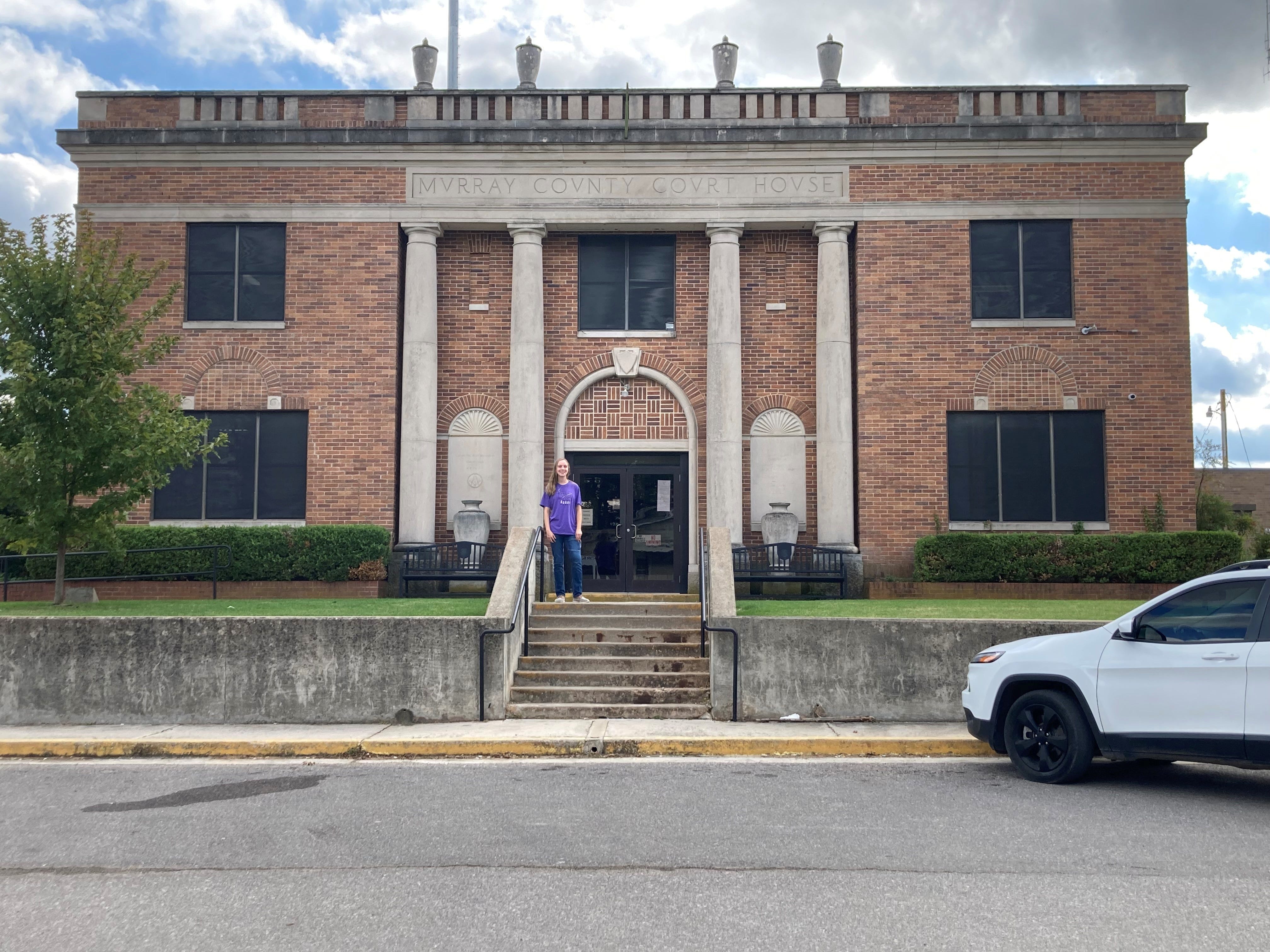
Mariana Horinek has been on a journey. She has visited all 77 counties in the state, viewing the rich history and culture found in local communities. She has also seen many parks and museums along the way and eaten wonderful food at local eateries. It is an effort to learn Oklahoma’s history through their respective courthouses, in her own personal way, outside of a textbook and off the beaten path, a chance to see what Oklahoma truly has to offer.
The Newkirk homeschooler finished her journey this past fall in far western Oklahoma, which included the Panhandle.
“We really took a trip to every courthouse in the state. Honestly, we had an adventure,” Horinek said of her years-long expedition. “We would go to a courthouse, take a picture and look around the grounds."
It began only a few years ago as a way to learn and explore history across the state while still being able to quarantine away from others during a pandemic.
“It all started with COVID-19, which was my freshman year,” she said. “My mother had an idea to do Oklahoma history and have a more hands-on learning experience.”
Her first foray into exploring Oklahoma and her courthouses started fittingly enough in neighboring counties.
“The first counties we went to were Osage and Washington, and we kept going,” she said. “It was a really special trip, because we were going to Missouri on vacation.”
All other trips were planned, however, an excursion to groups of counties to visit their court facilities, and anything else historical along the way, a chance to learn Oklahoma history in person.
Every county in the state has a courthouse, and a few struck her memory of her excursions along her journey, including one in the Panhandle.
“One of those was in Boise City. It was in a round-about (street), and I thought that was a cool thing,” Horinek said. “For some reason that one stuck out more.”
Most of those trips were taken on weekends, so they had to adapt to get pictures, as government buildings are closed on weekends.
“We actually didn’t go in any of them, so I’ve only been in the Kay County Courthouse,” Horinek said. “With us traveling on Saturday and Sunday, they weren’t open where we could go inside so we walked around them and looked at the architecture of the buildings.”
Even if the courthouses themselves were closed, she still found other ways to learn history in her adventures across the state.
They explored many local parks as part of their adventures when traveling.
“We went to Tenkiller Lake and camped in the back of our car,” she said. “We visited Robber’s Cave State Park and the Red River Museum near Idabel.”
Those museums were another educational experience, providing her a chance to learn about local history, something Horinek may not have learned otherwise. They visited museums in western Oklahoma, including the Museum of the Great Plains in Lawton.
“It was really hands-on learning about history, and I thought it’d be good for kids as well,” Horinek said. “They had a map on the floor where you could see where you were and a magnifying glass so you could see closer.”
Another museum in the Panhandle was more general, but had an extensive collection of artifacts.
“In Boise City, there was a museum, and it was filled with history. You couldn’t go through all of it, you’d have to spend the whole day in there,” she said.
Courthouses, parks and museums are only part of what Horinek learned along the way. She has also learned much about the geography of the state.
“I’ve actually been to the highest point, and the lowest point, in Oklahoma, or at least as far as we could get, because there wasn’t a marker for the lowest point,” she said.
That highest point was Black Mesa, in far northwest Cimarron County, the westernmost county in the state. Cimarron County borders Kansas, Colorado and New Mexico. The state’s lowest point is near Idabel.
“We hiked Black Mesa. It was an eight-mile hike, so that was a lot of fun,” she said.
As for the view from the roof of Oklahoma, it was beyond what she could have expected, being at such an elevation.
“There was a lot of brush because it is a little bit drier out there. There were a few trees, but nothing like here, where there are a lot of trees and grass,” Horinek said. “The view was good because you could see a lot of mesas. It was like being on a mountain top, but not quite.”
She also learned much about how diverse the geography of the state is, from eastern to western Oklahoma, northern to southern.
“It is amazing how many different ecological regions we have and how diverse Oklahoma is as a state, with having the mesas in the Panhandle, the flatlands and the mountains,” she said. “Usually, I see Oklahoma as a flatland, but there is a lot more diversity than that. Being from a small town, you don’t see everything.”
A Newkirk native, she has many memories inside the Kay County Courthouse, so she saved the local one for last. Horinek wanted to visit the other 76 facilities first.
“We wanted to finish in Kay County because this is home,” she said.
Horinek has stepped foot in all 77 counties, seen their respective courthouses and many other parks, historical locations and attractions across the state. She has learned so much in her explorations, including history, culture and the backroads of Oklahoma that not everyone gets to see, which was the point of the trip in the first place, all with her family.
“Since I’m homeschooled, I already spend time with my mom, but there is something special about taking a trip, not knowing where you’re going, just having an adventure,” she said.
The overall exploration, taking the backroads to where they were going, countrysides they had never seen, made for a truly immersing event, a real-life study in Oklahoma, all done in person. They knew the route and had fun exploring what makes Oklahoma truly an amazing state.
“Sometimes, using an Oklahoma atlas, I would tell mom, ‘We’re going to turn here, down a backroad.’ It would lead us where we’re going, but just the longer route, scenic route,” Horinek said. “There is so much more to Oklahoma.”
➡️ Opt in or out of different newsletters on your “My Account” page.
➡️ Learn more about Ponca City Monthly+
Ponca City Monthly is a locally owned publication that delivers hyperlocal news in print and online.
Like what we are doing? Feel free to forward this along and tell a friend.
Sponsorship information/customer service: email [email protected]