
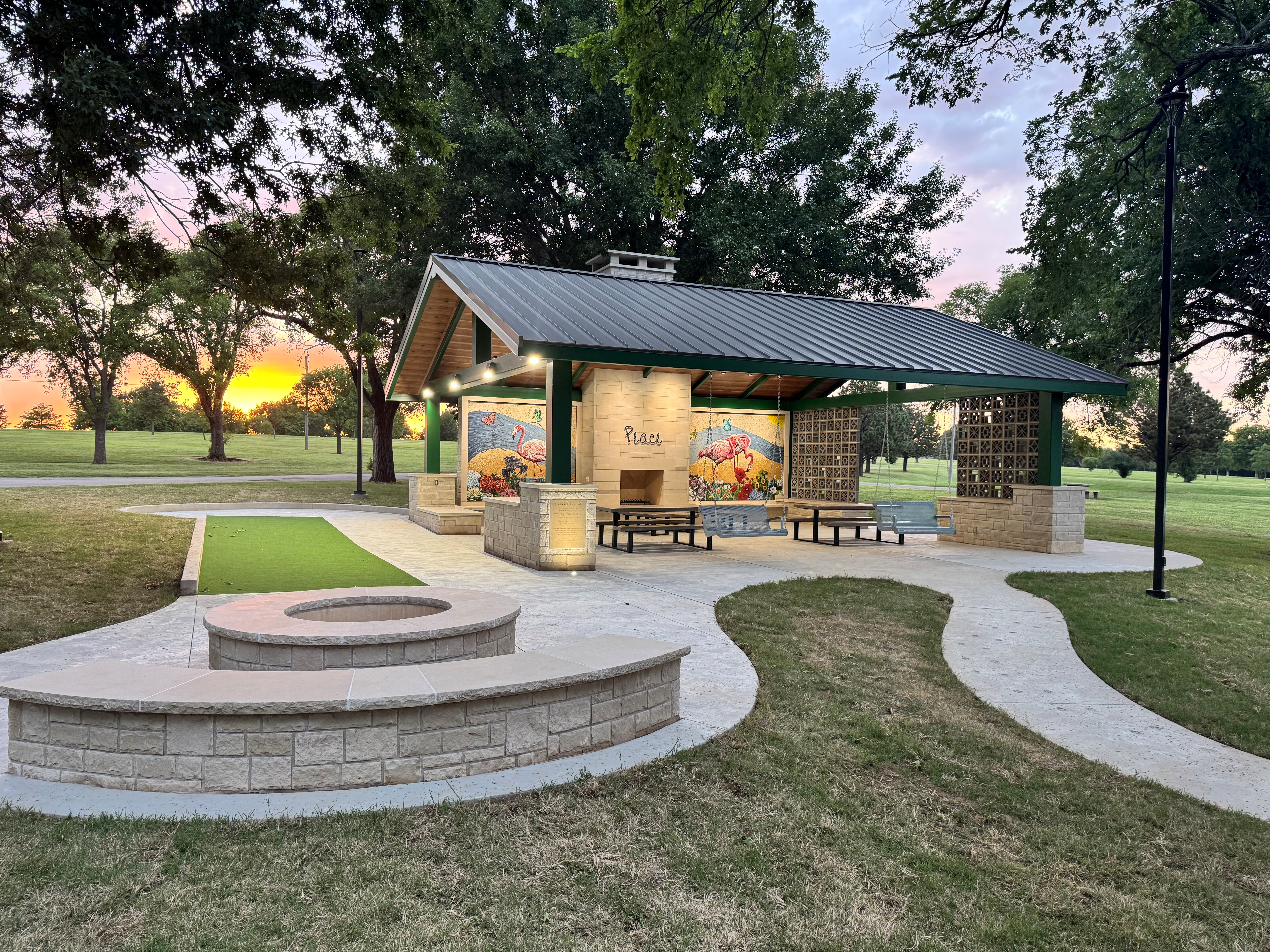
On a bright June afternoon at Lake Ponca, the Husen family dedicated the Peace Pavilion — born from love, shaped by memory, and given to Ponca City for generations to come
The sun was out over Lake Ponca — fitting, for a day honoring a woman who loved sunlight as much as Stephanie Husen did.
On a beautiful June afternoon, family, friends, city officials, and neighbors gathered at the water's edge for the ribbon-cutting and dedication of the Peace Pavilion, a new gathering place built in Stephanie's memory and given as a gift to the people of Ponca City. What followed was less a ceremony than a story told aloud — of love, friendship, remembrance, and community — by the people who knew her best and built the pavilion in her honor.
Because every place has a story. And to understand the story of the Peace Pavilion, you have to begin with the woman whose memory inspired it.
Dr. Stephanie Husen grew up in Ponca City, and she loved it here. She spent countless hours at Lake Ponca with friends and classmates — laughing, sharing the easy companionship of youth, doing the thing she would become known for her whole life: bringing people together. She was a physician, a sports medicine doctor serving her patients in Tulsa. She was 48 years old when she was killed on June 1, 2022, one of four people who lost their lives in a mass shooting at the Natalie Medical Building on the Saint Francis Hospital campus.
Those who loved her remember a woman of rare warmth — someone famous for valuing friendships, remembering the special occasions, and making the people around her feel seen. "She brought light into the lives of those around her," organizers said at the dedication. In the aftermath of unspeakable darkness, her family, Joyce and Greg Husen, chose to answer it with beauty and light. They decided to build something filled with both.
Why a pavilion
The question came up again and again as the family imagined how to honor her: why a pavilion?
The answer was Stephanie herself. She loved celebrations. She loved gatherings. She loved any excuse for people to be together. A pavilion is a space where people enjoy one another's company, mark important moments, and create lasting memories — and Lake Ponca, the place that meant so much to her growing up, was the natural home for it.
"A pavilion is a place where people gather," said Carl Sopranski, the landscape architect who led the design. "In many ways, that is exactly what Stephanie did throughout her life. She brought people together."
A friend's vision
Sopranski wasn't a stranger to the family. He and Stephanie had been forever friends since they were about three years old — meeting on the nature trail as children, spending hours exploring the outdoors, curious about how things worked and respectful of every living creature they encountered.
"In 27 years of being a landscape architect, I have never been scared of a project until this one," he told the crowd. "How can I possibly do Stephanie the honor and the remembrance in my vision?"
He didn't try to do it alone — fittingly, because Stephanie was never a loner. He enlisted designer Chris Murphy of Christopher Murphy Designs and architect Richard Winterode of Winterode Tally Architect, along with his own design team, Kelsey Osgood and Kyle Cox. Together they built a design narrative drawn directly from Stephanie's life. They sent friends and family questionnaires asking about her favorite places, colors, memories, and the qualities that best described her. Their answers shaped everything.
The pavilion was intentionally oriented toward Stephanie's childhood home, creating a lasting connection to the place where her story began. It stands on the very ground where she and her friends once spent Friday nights — long before there was any structure here — sitting and talking and laughing and imagining their futures.
Reading the design
Every element carries meaning.
The breeze blocks allow the wind to move freely through the pavilion, reflecting Stephanie's open and welcoming spirit. The turf area to one side creates room for games, laughter, and connection. A fireplace and fire pit were included because she loved gathering around a fire with the people she cared about. The green-painted steel structure honors her lifelong love of nature.
The word PEACE, mounted on the fireplace, was rendered in Stephanie's own handwriting — her personal notes and letters digitized and laser-cut so that her hand is, quite literally, part of the structure forever. An etched stone carries the four words that surfaced most often in the questionnaires, the qualities people most associated with her: grace, courage, balance, and harmony. Pressed into the concrete are dog prints, a tribute to her love of animals and her beloved dogs.
Paradise, in 40,000 tiles
At the heart of the pavilion is a mosaic by artist Karen Brown — eight months of work and roughly 40,000 hand-placed tiles of glass, porcelain, and mirror. Its name is Paradise.
Joyce Husen described it as something beautiful and creative set against the ugliness that sometimes surrounds us — perhaps a glimpse of the world as it was meant to be, perhaps a vision of heaven itself. The sun anchors the piece, because sunlight was one of Stephanie's favorite things. Flowers express happiness and color. Flamingos — which Stephanie loved, and which turned up tucked all over her house — stand for those four etched words: grace, courage, balance, harmony. Flowing blue water evokes the "sea of glass" of the Book of Revelation.
And above the water are butterflies, their wings shaped like hearts. Each butterfly represents an innocent victim of gun violence in the United States. According to the Gun Violence Archive, approximately 48,000 people died by firearms in 2022, with tens of thousands more injured.
"We hope those who visit the Peace Pavilion take time to let go of their challenges in this world and find peace in their hearts," Brown read, on the family's behalf. The hope is simple: that visitors pause, reflect on being kind to others, and value every life.
More than a memorial
For all its personal detail, the family always understood the pavilion to represent something larger than one person. Born from the loss of Stephanie and those who died alongside her, it is dedicated to all innocent victims of gun violence and to the families who carry their memory forward.
"This project became an outlet for all who participated," Greg Husen told the gathering — "not just to be kind, but to say, no, evil and darkness do not get the final word."
That conviction ran through the whole afternoon. Father Alex Frost of St. Mary's Catholic Church, offering the blessing, put it this way: when evil happens — and it does — "our response could be to cower in the darkness, but to respond with light, and beauty, and peace." He prayed that the peace of the pavilion would be more than the natural calm of the lake or the warmth of friends gathering: that real peace would dwell here.
A gift to the city
The Husen family thanked a long roster of people who gave their time and talent — Bill Russ, who helped get the project started and saw it through to completion; Bill Steever, always ready to help; the team at RCS, including project manager Chuck Fresco and owner Mitch Myers; the city's Parks and Recreation department; the Parks Advisory Board; and many donors and craftspeople. They reserved their deepest thanks for Carl. "No words can describe the time, thought, and effort you have given to this pavilion project," Greg said.
In the ceremony's final act, the family formally presented the Peace Pavilion to the City of Ponca City, accepted on the community's behalf with the support of city leadership. Then Joyce Husen and Brett Smith cut the ribbon.
The pavilion now belongs to the people of Ponca City — a place where families will meet, friends will share stories, and new memories will be made on the same ground where a young Stephanie Husen once imagined her future.
"Thank you for the memories, the laughter, and the years of friendship," Sopranski said, speaking to his friend one last time. "Although your time with us was far too short, you will continue to live in our hearts, in our stories, and now in this place that bears your memory. Rest peacefully. You will not be forgotten."